Raindrops fall from the sky on bare winter trees, their branches spread in the manner of a person wailing with arms spread out. The golden beams of a sun filtering through clouds turn these droplets into prisms that throw up curious combinations of emerald, green and turquoise. Another array of raindrops gleams like small mirrors, suspended to bare boughs running from one end to the other.
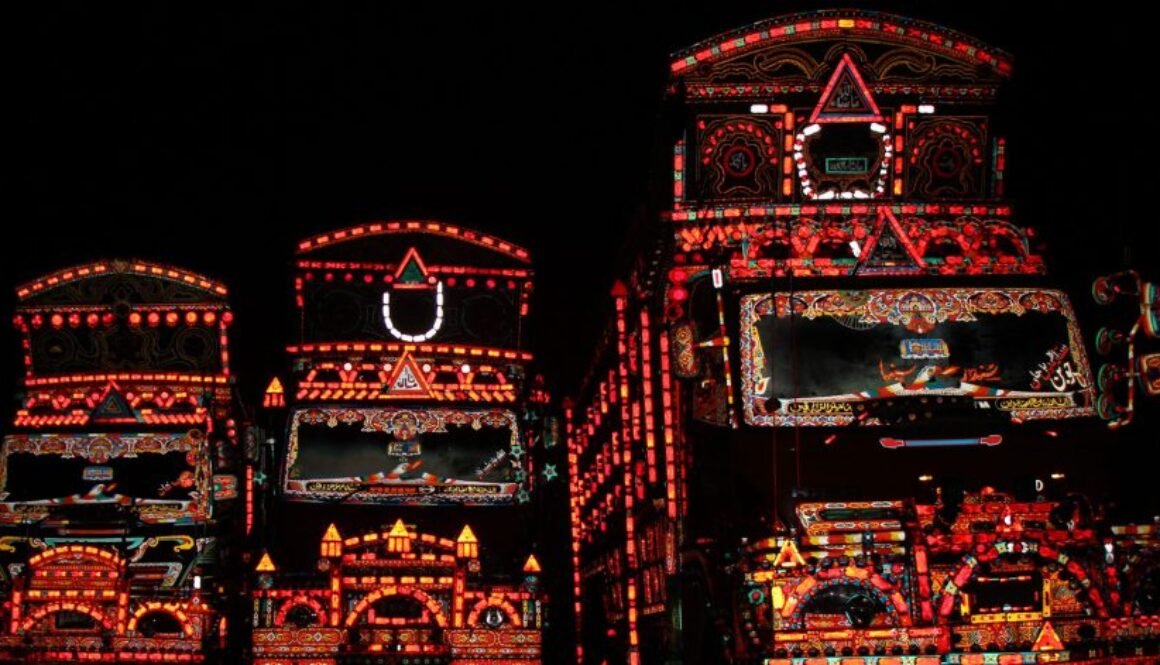
This is not a scene from a mountain valley coming back to life after heavy snows. It is not even the creation of a writer’s fertile imagination. It is part of the fantastical imagery often found painted on trucks plying across Pakistan. Be fascinated by it and call it truck art. Be detached and you will see it as mere decoration. For a truck driver, it is the make-up of his “bride”.
In the metamorphosis of a truck into a bride, the body parts of the vehicle assume human aspects. The silver, metallic decoration on top of the driving cabin is a taj, a crown; the windscreen is matha, the forehead; and the bonnet is hont or lips. The lowest part of a truck’s front – where the bonnet meets the chassis and tyres – is adorned with golden metal bells, ghunghroos, hanging by a series of vertical steel chains.
On hearing “no”, they would ask me: “You must be from Hunza, then?”
“No, I am from Quetta,” I would answer.
Their next guess would instantly be: “Then obviously you are a Pathan…”
“No, I am a Hazara.”
“Oh! So you are one of the people who are being persecuted.”
Persecuted. It is so painful to hear this every time I introduce myself. My friends, too, face the same situation when meeting someone new.
Incidents such as the one a few days ago in which members of a Hazara family travelling to Quetta from Chaman were fired upon, killing four of them, including a 12-year-old boy, have become part and parcel of what it is to belong to our community.
Be that as it may, the Hazaras, a long-oppressed and marginalised people, are also a very resilient one. Despite living with a sword hanging above our heads, we choose to look past the blood and bullets and attempt to have (with some strange measure of success) a semblance of a normal life.
Thus, I was driven to tell the story of my people and my surroundings. For that I launched a project called Humara Mohallah, which shows different neighbourhoods in Pakistan in interesting and relatable ways through visual storytelling
One such story, titled What we leave behind, is an attempt to show the Hazara community in Quetta persevering in the face of the inequities they face. It showcases the people who have been ravaged by the ongoing terrorism for nearly two decades.
The wanton persecution has prevented them not only from promoting their culture, but also severely hampered their participation in civic and public life.
The community is confined to a handful areas of the city: Alamdar Road and Hazara Town. It is a prison in the guise of a sanctuary.
The video features a graveyard, filled with the bodies of the people who have died in terrorist attacks and targeted-killings over the years. The story, however, is not just about the graveyard.
It tells much more — about a people who have repurposed the graveyard into a community centre, making it an integral part of their daily lives. A place of reflection, recreation, and ultimate destination, if you will.
A unique and beautiful graveyard where everyone’s loved ones are buried is the same place where a great many memorable moments are spent.
Having always been symbolised as a place of fear and unease, the word graveyard typically brings an almost irrational terror to one’s heart.
However, defying all conventional definitions of a cemetery stands Quetta’s Hazara graveyard: the Bihisht-e-Zainab.
Here, happiness begins from being amongst the dead. The locals celebrate Eid by going to the graveyard and remembering the loved ones they have lost —some souls lost to age, some to illness, while others ripped away at the end of a barrel.
Due to the lack of parks — or any other place to hang out — each day begins with a group of men and women making their morning rounds in the graveyard premises.
As the sun rises, the rejuvenating light chases away the dark insecurities of the night, and life begins anew, the deafening song of birds shattering the stillness of the cemetery.
When the clock strikes 10, the vegetable market — located within it — gets filled with women and one can hear the pleasurable sounds of their bangles jingling complemented with the sweet, chirping of their voices.
Along with these women, children can also be seen playing and their elated shrieks fill the atmosphere with a sense of community. A sense of belonging. An illusion of peace.
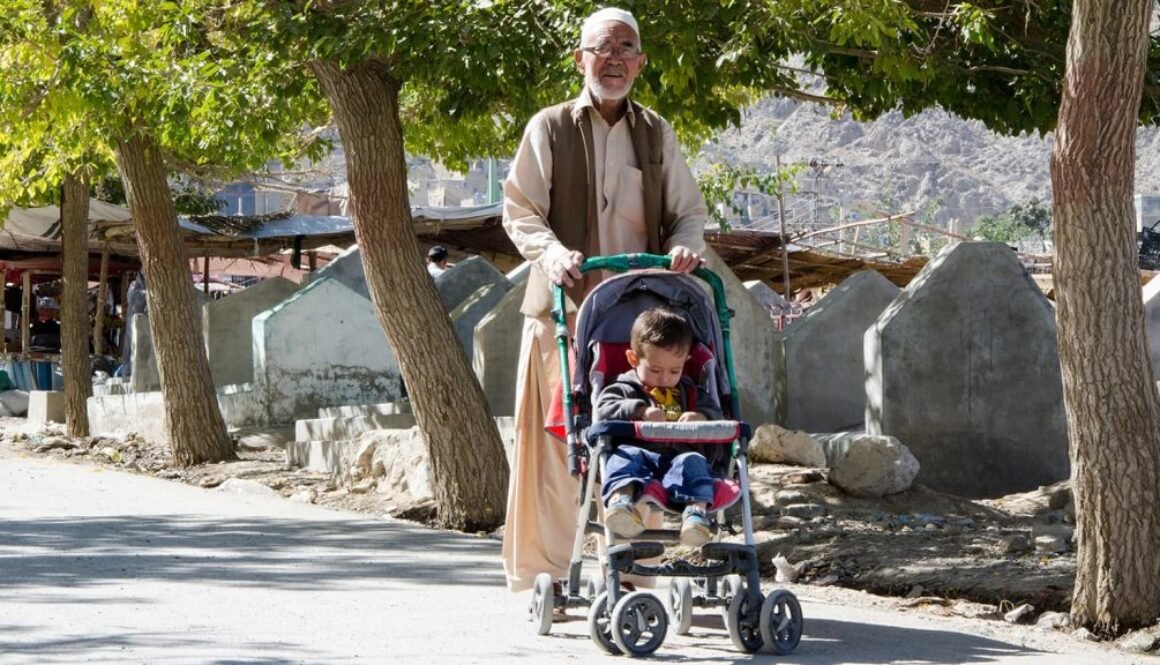
One day I met an old man passing by on a street in the graveyard. I found myself compelled to strike a conversation with him. I asked the man where he was off to, to which he replied, “I’ve brought my grandson for an outing so his mother can perform her household chores in peace.” The child was gleefully absorbing the sights and sounds from his pram, feeling at home in the resting place of his forefathers.
Just a few paces away from there, some old men sit languidly under the tranquil shade of trees every day, and reminisce about their fascinating past, no doubt one-upping each other, trading barbs or just sharing stories of happiness and heartaches.
The evening brings with it the most important activity of the day. The stones that are used to mark the graves are given a decidedly less morbid purpose. They are used as an accessory in the game of Sang Girag which the people of Hazara have been playing for centuries.
In the game, two teams of three to five players hold smooth round stones — typically the size of a cricket ball — and turn by turn, hurl them at a cylindrical target called a qarqa. Striking the qarqa gets you a point. The team that is the first to reach 10 points is declared the winner.
People of all ages partake in the action, even octogenarians. Others sit and watch, cheering for the ones they support and laughing at every misstep, many holding prayer beads in their hands.
As night falls, like clockwork, the people make their way back through the pathways of the graveyard that branch off to their respective homes, only to return the next morning to add soul to what would have otherwise been a place devoid of life.
One might wonder why a cemetery has been chosen for the purpose of community building. Due to the widespread fear of being attacked, the people largely do not leave their homes and instead find comfort in a place nearby.
The mountains surrounding our homes act as natural sentries, keeping us safe.
The graveyard offers the distinct advantage of providing a safe space for people to gather as it is guarded by mountains on three sides and the streets all lead straight to their homes.
Though craggy stone, the dry, gray behemoths are perpetual sentries, proving to be effective protection for a people who have been forced to rely on inanimate objects and natural escape routes for their safety.
More than a century old, the graveyard, which once saw only a handful of visitors, now sees an entire community making full use of the only escape they have and, ironically, celebrating their lives among the dead, defiant in the face of systematic ethnic and sectarian attacks and hatred.
Turkey has signed a deal with Russia to buy S-400 missile defence systems in its first major weapons purchase from Moscow, Turkish newspapers on Tuesday quoted President Recep Tayyip Erdogan as saying.
The accord for the surface-to-air missile defence batteries is Ankara’s most significant pact with a non-Nato supplier.
“Signatures have been made for the purchase of S-400s from Russia. A deposit has also been paid as far as I know,” Erdogan said in comments published in the Hurriyet Daily and other newspapers.
“(Russian President Vladimir Putin) and myself are determined on this issue,” he told journalists.
The purchase of the missile systems from a non-Nato supplier will raise concerns in the West over their compatibility with the alliance’s equipment.
The Pentagon has already sounded alarm, saying bluntly that “generally it’s a good idea” for Nato allies to buy interoperable equipment.
Erdogan said Turkey was free to make military acquisitions based on its defence needs.
“We make the decisions about our own independence ourselves, we are obliged to take safety and security measures in order to defend our country,” he said.
Moscow also confirmed the accord, with Vladimir Kozhin, Putin’s adviser for military and technical cooperation, saying: “The contract has been signed and is being prepared for implementation.”
He said that the S-400 was one of the most complex systems, made up of a whole range of technical materials.
“I can only guarantee that all decisions taken on this contract strictly comply with our strategic interests,” he was quoted as saying by Russian state-owned [TASS]2 news agency.
“For this reason, we fully understand the reactions of several Western countries which are trying to put pressure on Turkey,” he added.
Russia’s relations with Nato have been in crisis over its annexation of Crimea from Ukraine and for backing pro-Moscow separatists in eastern Ukraine.
Turkey, a Nato member since 1952, has currently troubled ties with the United States over a number of issues including Washington’s support of the People’s Protection Units (YPG) Syrian Kurd militia which Ankara considers a terror group.
Myanmar leader Aung San Suu Kyi will not attend the United Nations General Assembly later this month, her spokesman said on Wednesday, as the Nobel laureate faces a barrage of criticism over her failure to speak up for Rohingya Muslims fleeing Rakhine state in huge numbers.
A crackdown by Myanmar’s army, launched in response to Rohingya militant attacks on August 25, has sent some 370,000 Rohingya refugees scrambling across the border to Bangladesh in less than three weeks. The violence has incubated a humanitarian crisis on both sides of the border.
Bangladesh is struggling to provide relief for exhausted and hungry refugees — some 60 per cent of whom are children — while nearly 30,000 ethnic Rakhine Buddhists as well as Hindus have been displaced inside Myanmar.
UN human rights chief, Zeid Ra’ad Al Hussein, accused Myanmar of waging a “systematic attack” on the Muslim Rohingya minority and warned that “ethnic cleansing” seemed to be under way.
Suu Kyi, Myanmar’s first civilian leader in decades, does not control the actions of the powerful military, which ran the country for 50 years before allowing free elections in 2015.
There is also scant sympathy among Myanmar’s Buddhist majority for the Rohingya, a stateless Muslim group branded ‘Bengalis’ — shorthand for illegal immigrants. But outside of her country Suu Kyi’s reputation as a rights defender is in ruins over the Rohingya crisis.
Rights groups have pilloried the former democracy activist for failing to condemn the army campaign, which has left hundreds dead. Rohingya refugees have told chilling accounts of soldiers and firing on civilians and razing entire villages in northern Rakhine state with the help of Buddhist mobs.
The army denies allegations, while Suu Kyi has also played down claims of atrocities instead blaming “a huge iceberg of misinformation” for complicating the conflict.
“The state counsellor won’t attend the meeting of the United Nations General Assembly,” said government spokesman Zaw Htay, using Suu Kyi’s formal title. The spokesman did not explain the decision but said the country’s Vice President Henry Van Thio would attend the summit, which runs through next week.
The UN’s National Security Council also plans to meet behind closed doors on Wednesday to discuss the crisis, although China has indicated it will shoot down any attempt to censure its strategically pivotal Southeast Asian ally.
Fallen star
Suu Kyi, a Nobel Peace Prize winner garlanded for her dignified and defiant democracy activism under Myanmar’s former junta, was once the darling of the international community.
She made her debut before the UN assembly last September, winning warm applause for a speech delivered months after she became Myanmar’s first civilian leader in decades. In it, she vowed to find a solution to long-running ethnic and religious hatreds in Rakhine “that will lead to peace, stability and development for all communities within the state.”
In a sign of how far her star has fallen since, she has been blasted by the same rights groups that campaigned for her release from house arrest for failing to speak up in defence of the Rohingya.
Sympathisers say her hands are tied by the army, which still runs a chunk of the government and has complete control over all security matters. But fellow Nobel laureates have lined up to condemn her silence, with Archbishop Desmond Tutu calling it “incongruous for a symbol of righteousness to lead such a country.”
Denied citizenship by Myanmar, the Rohingya are loathed in Buddhist-majority Myanmar and unwanted by Bangladesh, which is providing temporary shelter to the refugees.
The US and other Western powers have rebuked the military campaign. But ahead of the UN Security Council meeting, Beijing on Tuesday offered Myanmar support saying the country was entitled to “safeguard” its stability.
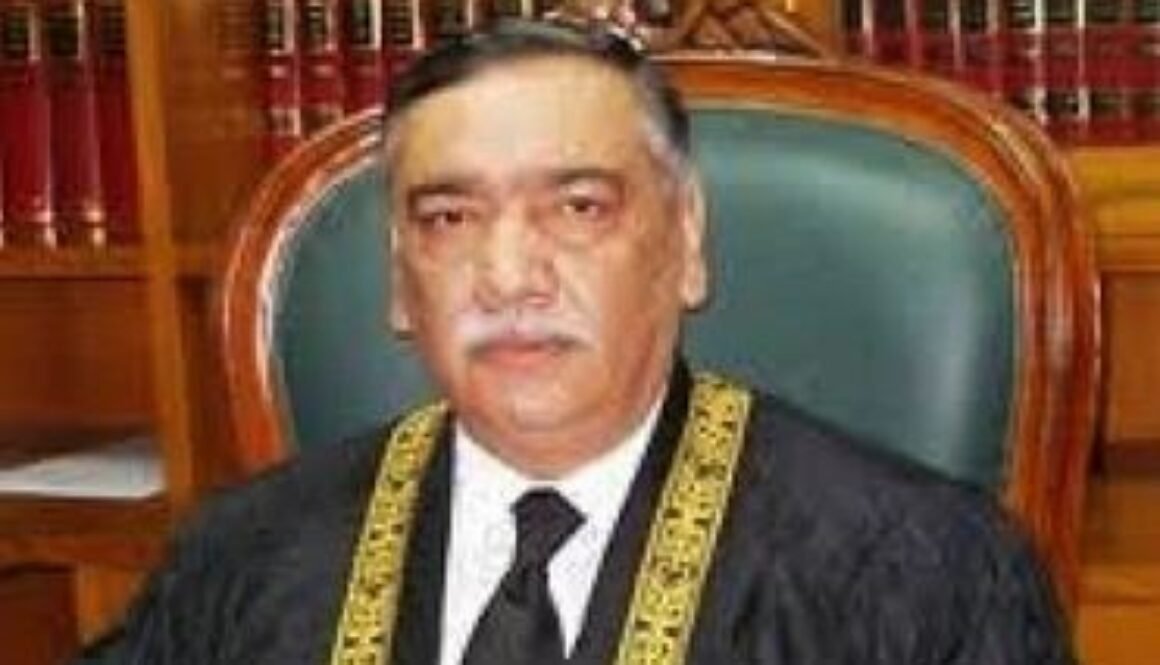
Justice Asif Saeed Khosa, who headed the five-member Supreme Court bench that issued the decisive Panama Papers verdict disqualifying former prime minister Nawaz Sharif, made clear on Wednesday that all judges on the bench had agreed on the July 28 judgement.
The same five-judge bench that decided upon the Panama case began hearing on Wednesday the review petitions filed by former prime minister Nawaz Sharif and his children against the July 28 judgement. The bench also comprises justices Gulzar Ahmed, Ejaz Afzal, Azmat Saeed and Ijazul Ahsan.
Senior counsel Khawaja Haris Ahmed who appeared on behalf of Sharif, argued that the two judges who had written dissenting notes against Nawaz in the initial April 20 judgement of the case could not have signed the verdict issued by the five-member bench on July 28.
The two dissenting judges in the April 20 order — Justice Khosa and Justice Gulzar — had signed on a “different” verdict on July 28, the counsel maintained.
Justice Khosa, however, informed the counsel that the final verdict had been signed by all five judges, and the bench members had previously disagreed only over the formation of the Joint Investigation Team (JIT).
“None of the three judges [who ruled in favour of further investigation on April 20] said they disagreed with the minority verdict [of disqualifying Sharif]”, he emphasised.
Justice Khosa said the two judges who ruled in favour of disqualification on April 20 did not add anything in the July 28 verdict.
Dissenting judges also sign final judgements, he said, adding that similar examples existed in judicial history.
Chief Justice of Pakistan (CJP) Mian Saqib Nisar had on Tuesday ordered the formation of a five-member larger bench to hear the review petitions filed by Sharif, his children and Finance Minister Ishaq Dar against the Panama Papers case verdict.
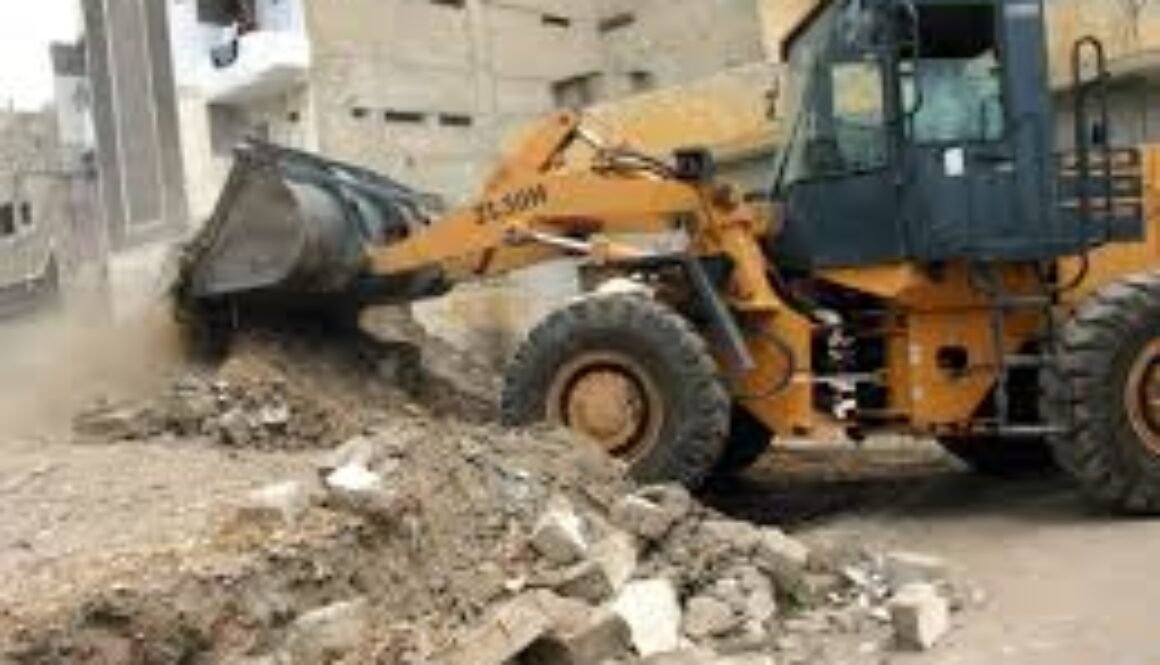
IF anything rivals the chaos of traffic across the country, it is the endless line of encroachments and blockades on the same roads on which the vehicles ply. From large cities such as Karachi to smaller towns, often even rural settlements, everyone, it would appear, wants to appropriate some part of the street for themselves. Anti-encroachment drives have produced mixed results, and in many instances, the illegalities return as soon as the authorities’ attention is diverted. Now the traffic police in Lahore have launched a programme that tries to reimagine the way in which encroachments and illegal parking lots on the city’s roads can be dealt with. Launched on July 31, the One Week, One Road initiative involves eight of the department’s better qualified wardens who have been chosen to form two squads to visit various areas in the city to select one road where encroachments are to be cleared, engage with traders and shopkeepers to brainstorm ideas on how deficiencies can be rectified, and prepare assessments of the roads in the context of the availability (or absence) of traffic signals, street lights, U-turns, etc. On Thursday, Lahore Chief Traffic Officer Rai Ijaz told the media that earlier the Mughalpura Link Road and Allama Iqbal Road — both extremely high-density thoroughfares — had been cleared of encroachments and illegal parking lots. Now, he said, Queen’s Road and Bund Road — where obstructions to the free flow of traffic are often of legendary proportions — are being focused on, and warning notices have been sent to 148 shopkeepers.
One must hope that the Lahore initiative is successful; if the authorities are able to find a sustainable solution to one of the country’s most pressing problems, more power to them. Engaging with the encroachers, rather than simply razing their means of livelihood, and addressing issues such as the shortage of legal parking lots, may be the key to this solution. Other city administrations must look on with interest, for if it works, the programme can be replicated in their jurisdictions.
ISLAMABAD: Pakistan will try to convince Chinese authorities to revise the existing free trade agreement (FTA) on the less-than-equal reciprocity principle, Commerce Minister Pervaiz Malik told Dawn on Friday.
The move is aimed at overcoming the trade imbalance that exists between the two countries.
“We will demand an early-harvest programme in the existing FTA that will cover 100 items of Pakistan’s export interest,” Mr Malik said.
Negotiation teams briefed the minister about the trade agreements with China and Thailand. The briefing was part of the preparation ahead of the eighth round of negotiation on the second phase of the FTA to be held in Beijing on Sept 14-15.
Commerce Secretary Younus Dagha will lead a technical team to represent Pakistan in the secretary-level talks.
Eighth round of negotiation on the 2nd phase of trade pact to begin next week
Mr Malik said China signed several bilateral and regional FTAs, which limited the benefit of preferences to Pakistan. China’s FTA with the Association of Southeast Asian Nations countries has also made the preferential treaty for Pakistan mostly irrelevant. For example, China charges 3.5 per cent duty on the import of yarn from Pakistan under the FTA while it also charges the same duty on imports from India without any treaty.
This shows the FTA has become mostly irrelevant for Pakistan. The minister said his ministry has worked out various proposals that will be presented during the upcoming round of negotiations.
The minister said Pakistan will urge China to enter into the early-harvest programme. “We also raised this issue with Pakistan’s foreign minister before his visit to China,” he said, adding that the ministry also sought help from the Foreign Office to make the treaty beneficial.
But another official told Dawn that Pakistan may not sign the second phase of the FTA as it fears that the move will further increase imports from China. Authorities in Beijing are unwilling to accept Islamabad’s demand for the revival of the preferential treatment for exportable products under the FTA, the official added.
As per the original plan, the second phase was supposed to be implemented from Jan 1, 2014. Both countries started negotiations for the second phase in 2011. The FTA covers more than 7,000 tariff lines at eight-digit tariff code under the Harmonised System (HS). Both sides have held seven rounds of negotiation on the second phase to break the deadlock.
An official statement issued after the meeting said the commerce minister showed satisfaction over the progress of the FTA negotiations. He directed the negotiating team to work vigorously to conclude the agreement in the best interest of Pakistan.
Currently, Pakistan has reduced the duty on 35pc products to zero per cent while China has reciprocated by reducing the duty on 40pc products of Pakistan’s exports to zero per cent. The official said Islamabad was also reviewing the services agreement with the Chinese authorities.
A commerce ministry report revealed that Pakistan could not utilise the concessions granted by China under the first phase. It only exported in 253 tariff lines, where the average export value was $500 or more, which was around 3.3pc of the total tariff lines (7,550) on which China granted concessions to Pakistan.
Pakistan’s key exports to China were raw material and intermediate products, such as cotton yarn, woven fabric, grey fabric etc. Value-added products were missing despite the fact that some of these products, like garments, were included in the concessionary regime.
On the FTA with Thailand, the minister said it was still in the early stage. However, he said interests of local industries will be protected under the proposed FTA. Thailand demands market access for the auto sector and rice.
Angry parents scuffled with Indian police in riot gear at an international school near New Delhi on Saturday after a staff member was arrested for slitting the throat of a seven-year-old boy.
The body of the boy was found in the bathroom of the Ryan International school in Gurgaon on Friday.
Police said that the boy was attacked with a knife after resisting a sexual attack allegedly by a bus attendant at the school.
“The accused has confessed to the crime during questioning,” Simardeep Singh, a deputy commissioner of police in Gurgaon, told AFP.
The boy resisted the sexual assault and the attacker decided to kill him to cover up the crime, Singh said. The suspect had been working at the school for eight months, the officer said.
Parents of the nearly 1,000 students at the school tried to storm the campus on Saturday to demand the arrest of school managers over the case.
But hundreds of police in riot gear guarded the building to avoid a repeat of violence on Friday when chairs and cupboards were smashed.
The school has suspended the principal and assured cooperation with the investigators.
Authorities said that they had launched an investigation into security at the school.
Ranked among the top educational institutions in the country, Ryan International runs nearly 150 schools across India and in the United Arab Emirates.
The school was caught in another controversy last year after a six-year-old student was found dead in a water tank at its New Delhi establishment.
Police had arrested the principal, a teacher and three oth
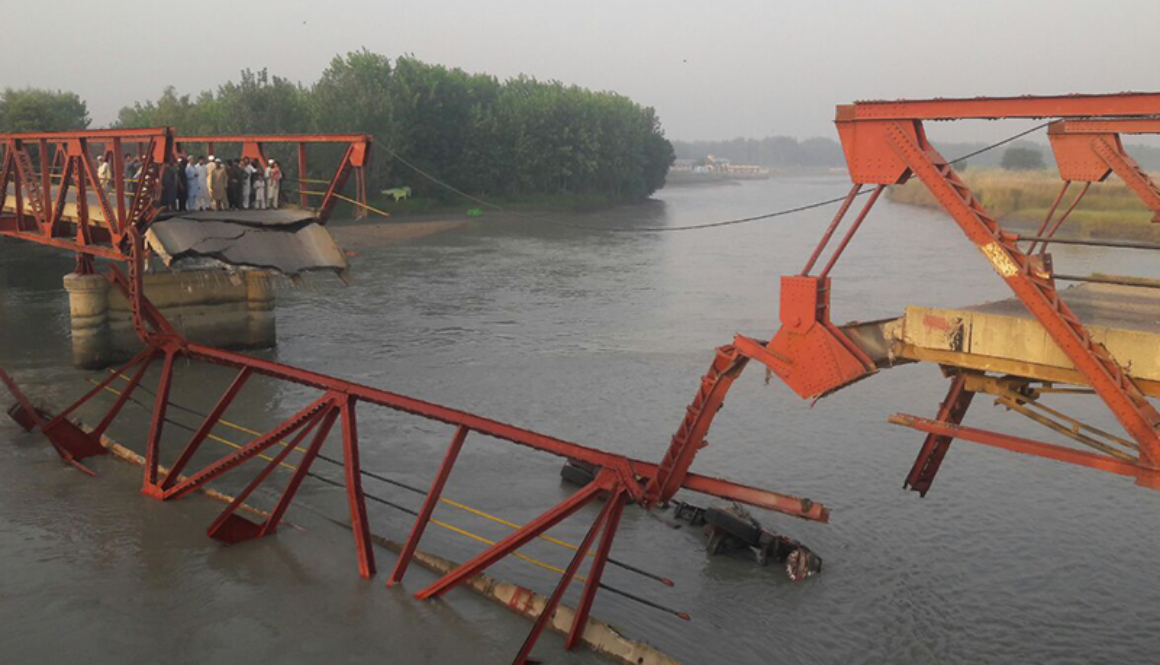
One man died and two others were injured when a bridge built on the Kabul River collapsed in Khyber Pakhtunkhwa’s Charsadda district on Saturday.
The incident occurred when a truck carrying cement was crossing the bridge constructed over Kabul River at Sardaryab, Assistant Sub-Inspector (ASI) Sayam told DawnNews.
The 10-wheeler truck carrying 1,600 bags of cement was on its way from Peshawar to Charsadda, and fell into the river following the collapse.
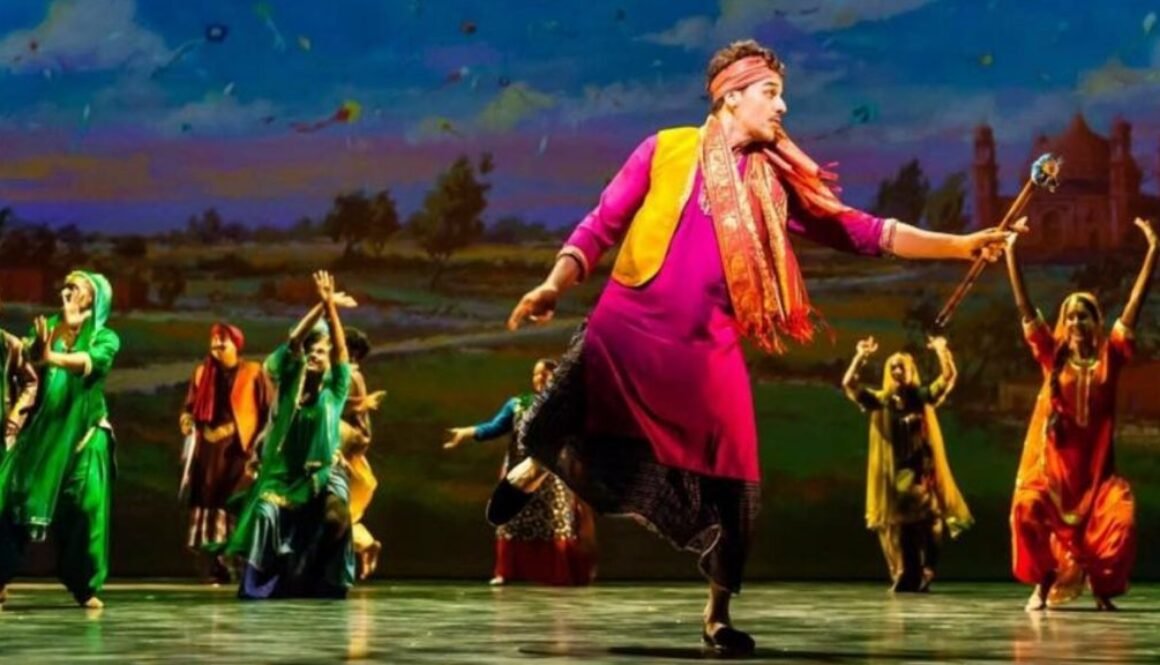
New musical ‘Ishq’, starring Ahsan Khan, Adnan Jaffer and Rachel Viccaji, marks a first for London theatres.
Based on the folk tale of Heer Ranjha, the play is London’s first Anglo-Punjabi production, according to the play brochure.
“The play is a celebration of 70 years of Pakistan and [hopes to spread] the Sufi message of love and peace,” shared Ahsan with Images. Ahsan plays the titular Ranjha in the musical.
The play opened on September 7 and has its final show tonight.
About his London stage debut, Ahsan shared, “Theatre is by far the most rewarding experience for an actor. You rehearse a character for a few weeks and then one day, at 7.30pm, you start performing and nobody stops you. You act with your entire soul. Thank you London for being an overwhelmingly appreciative audience.”
Here are some scenes from Ishq:
Ahsan Khan plays the titular RanjhaAhsan Khan and Rachel Viccaji in IshqHeer Ranjha is the story of a man and woman from warring villages who fall in loveAdnan Jaffer during an intense moment of the musical
The cast takes a bow
The play features Emu from Fuzon as composer and Suhaee Abro as choreographer. It has been directed by Farooq Beg, produced by Huma Beg and written by S. Mushfiq Murshed.